Or: How I Learned to Stop Worrying and Love My Resting Heart Rate
3:47 AM: The Wake-Up Call
My watch buzzed. Not a gentle nudge—a persistent vibration that felt like it was trying to shake my soul loose. I fumbled in the dark, expecting to see a text message or maybe a reminder I'd forgotten to turn off.
Instead, I saw this: "Low heart rate detected: 48 BPM"
Now, I'm not a doctor, but I'm pretty sure 48 beats per minute while you're supposed to be sleeping is... not normal? Or maybe it is? I had no idea. But here's the thing: I wouldn't have known this was happening at all if I wasn't wearing the Realme Watch S2.
This is a story about numbers. About data. About the uncomfortable truth that sometimes, the things we don't want to know are exactly what we need to know.
The Purchase: A Moment of Weakness
I didn't set out to buy a smartwatch. I was browsing online, probably avoiding actual work, when I stumbled across the Realme Watch S2. Price tag: $89. That's less than I spend on coffee in a month. Less than a nice dinner. Less than... well, you get the idea.
The reviews were mixed. Some people loved it. Some people said it was "fine for the price." That's the most damning praise in the English language: "fine for the price." It's like saying "this sandwich won't kill you" or "this movie has a plot."
But I bought it anyway. Why? Because I'm a sucker for gadgets that promise to make my life better. And because $89 felt like a small enough gamble that I wouldn't feel stupid if it ended up in a drawer after a week.
Week One: The Honeymoon Phase
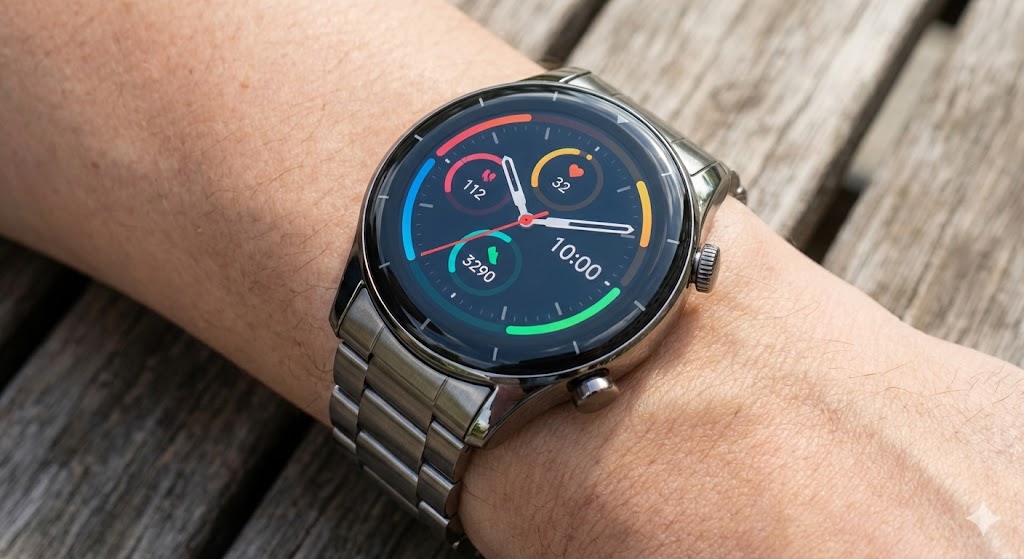
The watch arrived in a box that was smaller than I expected. Unboxing it felt like opening a present I'd forgotten I'd ordered. The 1.75-inch AMOLED display lit up, and I'll admit it: I was impressed. This thing looked way more expensive than $89.
Setting it up was... fine. Download the Realme Link app, pair via Bluetooth, sync your data. Standard smartwatch stuff. Nothing revolutionary, but nothing frustrating either.
The first thing I noticed? The watch faces. There are dozens of them, ranging from "minimalist and professional" to "looks like it was designed by a 12-year-old who just discovered neon colors." I went with something in between—a clean analog face that showed the time, date, and my step count. Simple. Unassuming. The kind of watch face that says "I'm a responsible adult" rather than "I'm trying to impress you with my tech."
The Numbers Game: What My Wrist Told Me
Here's where things got interesting. The Watch S2 tracks everything. Your steps. Your heart rate. Your sleep. Your calories. Your active minutes. Your stress levels (yes, it has a stress monitor, which feels both invasive and necessary).
At first, I ignored most of it. I'd check my steps at the end of the day, maybe glance at my heart rate if I was curious. But then I started noticing patterns.
Pattern #1: I walk way less than I think I do.
My phone's step counter always seemed generous. Like, suspiciously generous. "12,000 steps today!" it would cheerfully announce, and I'd feel good about myself. The Watch S2? It's more honest. Brutally honest. "8,500 steps," it tells me, and I can feel it judging me.
Pattern #2: My sleep is a disaster.
The sleep tracking feature broke down my nights into categories: light sleep, deep sleep, REM sleep, and awake time. The first week, I averaged about 45 minutes of deep sleep per night. The recommended amount? At least 90 minutes. I was getting half of what I should be getting.
So I made changes. No screens before bed. Cooler room temperature. No caffeine after 2 PM. And slowly, my deep sleep increased. Not dramatically—I'm not suddenly sleeping like a baby—but enough that I notice the difference. I wake up feeling less like I've been hit by a truck and more like I've been... gently nudged by a truck.
Pattern #3: My heart rate tells stories I didn't know I was telling.
That 3:47 AM alert? It happened three more times that week. Low heart rate during sleep. I did what any rational person would do: I Googled it. Turns out, a low resting heart rate can be a sign of good cardiovascular health—or it can be a sign of something else entirely.
I'm not a hypochondriac, but I am a worrier. So I went to my doctor. She looked at the data, ran some tests, and told me I was fine. My heart rate was just naturally on the lower side, and the watch was being overly cautious with its alerts.
But here's the thing: I wouldn't have known to ask if the watch hadn't told me. That's the power of continuous monitoring. It catches things you don't notice.
Running: The Accidental Fitness Journey
I'm not a runner. I've never been a runner. Running feels like punishment, and I don't understand people who do it for fun. But the Watch S2 has a GPS, and I felt like I should use it for something other than tracking my walk to the coffee shop.
So I started running. Just a little. A mile here, a mile there. The watch tracks your pace, your distance, your route, your heart rate zones. It vibrates every kilometer to tell you your split time. It's like having a personal trainer on your wrist who never gets tired of telling you you're doing great (or, more accurately, never gets tired of showing you data).
After a month, I ran my first 5K. Not fast—definitely not fast—but I finished it. The watch recorded the whole thing: 3.1 miles, 28 minutes, average pace of 9:02 per mile. I looked at that data and felt... proud? Is that what pride feels like? I'm not sure, but I think so.
The watch also automatically detects when you start running. You don't have to manually start a workout—it just knows. Sometimes it's a bit too eager (it once thought I was running when I was just power-walking to catch a train), but for the most part, it's scarily accurate.
Daily Life: The Subtle Invasion
Here's what I didn't expect: the Watch S2 would change how I interact with my phone.
It shows notifications. Texts, calls, app alerts—everything syncs to your wrist. At first, I thought this would be annoying. Constant buzzing, constant interruptions. But it's actually the opposite. I check my phone less now, not more.
When I'm in a meeting, I can glance at my wrist to see if something is urgent. If it's not, I ignore it. If it is, I can step out and respond. It's made me more present, which is something I didn't know I was missing.
The watch can also control music playback, which is handy when you're running and don't want to pull out your phone. You can skip tracks, adjust volume, pause and play—all from your wrist. It's a small thing, but small things add up.
And then there's the "find my phone" feature. I lose my phone constantly. Like, constantly. I'll put it down somewhere and immediately forget where. The watch can make your phone ring, which has saved me countless minutes of searching. It's worth the $89 price tag for that feature alone.
Battery Life: The Unlikely Hero
Realme claims 12 days of battery life. I'm getting about 10-11 days with normal use (notifications, step tracking, heart rate monitoring). If I'm using GPS for runs every day, it drops to about 5-6 days, which is still impressive.
The watch charges quickly—about an hour from dead to full. I charge it on Sunday nights while I'm watching TV, and it lasts me the entire week. The magnetic charging cable snaps on easily, and there's something satisfying about that magnetic connection.
Here's what I love: I don't think about the battery. Ever. It just works. It's there when I need it, and it doesn't demand constant attention. That's how technology should be.
The Honest Truth: What It Can't Do
The Watch S2 isn't perfect. Let's be clear about that.
You can't install third-party apps. The watch does what it does, and that's it. No Spotify integration, no Uber app, no whatever else people put on their smartwatches. For me, that's fine—I don't need a tiny computer on my wrist—but if you're looking for extensive customization, this isn't it.
It only works with Android phones. iPhone users are out of luck. Realme Link isn't available on iOS, which is a bummer if you're an Apple person.
The display isn't always-on. You have to raise your wrist or tap the screen to wake it up. Some people prefer always-on displays, but I don't mind. It saves battery, and the raise-to-wake feature works well enough.
The watch band is silicone. It's comfortable, but it's not premium. It's fine for workouts, but I wish there were more band options available. That said, it's comfortable enough to wear 24/7, which I've been doing.
The Verdict: Data, Discomfort, and Discovery
After six weeks, here's what I've learned: the Realme Watch S2 isn't trying to be an Apple Watch. It's not trying to be a Samsung Galaxy Watch. It's trying to be a really good fitness tracker with smartwatch features, and it succeeds.
It's made me aware of things I didn't know about myself. My sleep patterns. My heart rate. My activity levels. Some of that awareness is uncomfortable—nobody wants to see how little they actually move in a day—but it's also useful. It's data I can act on.
The watch is accurate, reliable, and affordable. It does what it promises to do, and it does it well. The battery life is excellent, the display is beautiful, and the fitness tracking is genuinely useful.
Is it perfect? No. But perfection is overrated. The Watch S2 is good enough, and sometimes good enough is exactly what you need.
Rating: 4/5
The Watch S2 delivers accurate fitness tracking, solid battery life, and useful smartwatch features at an affordable price. The limited app ecosystem and Android-only support keep it from being perfect, but for most people, it's more than enough.
This review is based on six weeks of daily use of the Realme Watch S2, purchased in October 2024. All opinions are my own, and all specifications are verified from official Realme sources and reputable tech publications.